Guide
Who Can Install a Gas Range? Trades, Fit and Common Mistakes
A licensed plumber or gas fitter should connect a gas range. See who handles each step, what a pro-style range needs, and the mistakes that cause service calls.
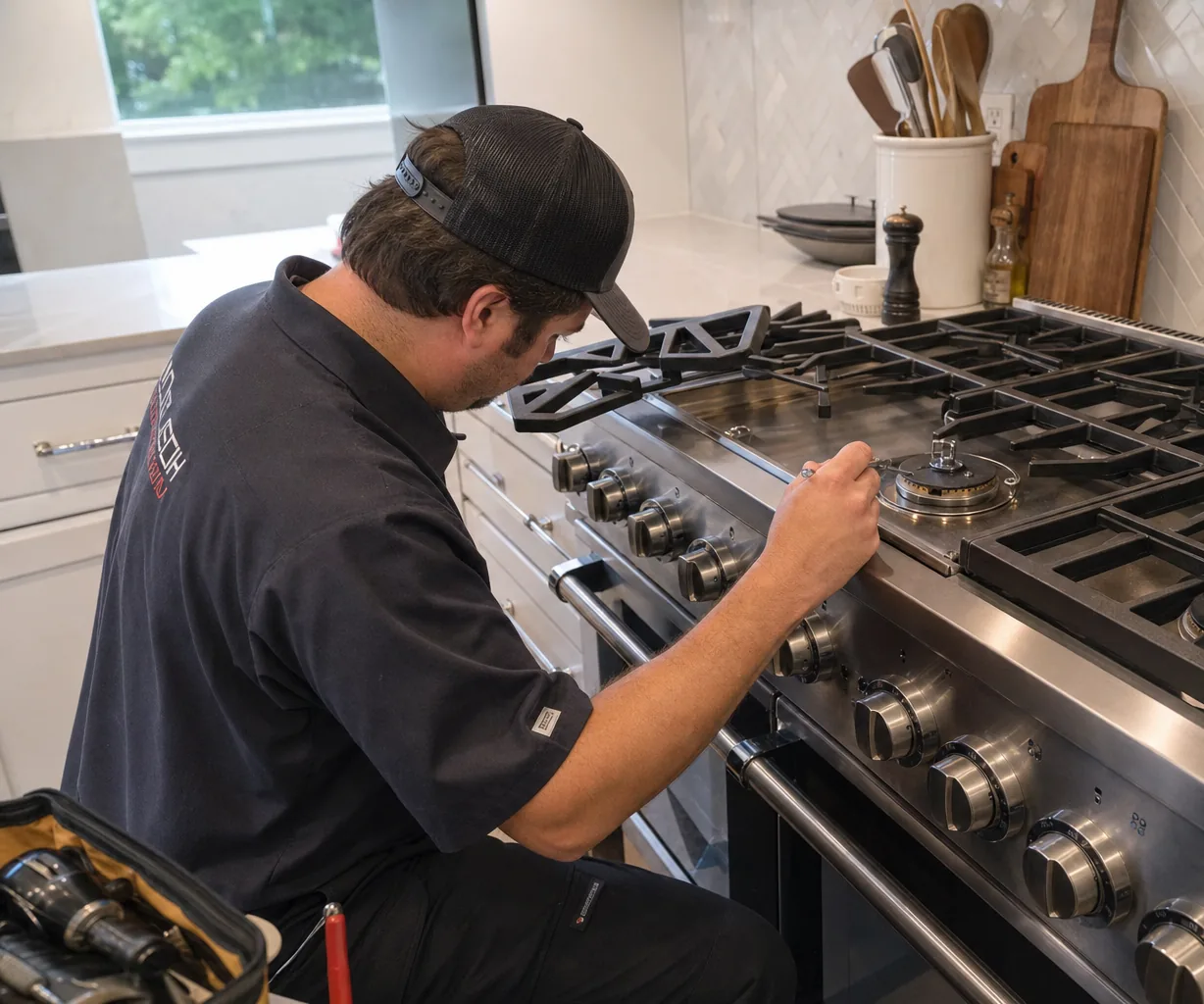
A licensed plumber or gas fitter should install a gas range, because connecting an appliance to the gas line is licensed work in Connecticut and range makers’ instructions call for a qualified installer. Plan on up to 3 trades: the delivery crew sets the range in place, the gas fitter connects and leak-tests it, and an electrician steps in only if a dual fuel model needs a new 240-volt circuit.
Pro-style ranges from Viking, Wolf or Thermador are heavier, deeper and more powerful than a standard stove, so getting the fit, gas and power right on day one prevents many later repair calls.
Who does which part of a gas range installation?
| Task | Who usually does it |
|---|---|
| Delivery and placement | Retailer’s delivery crew |
| Shutoff valve, piping, connector, leak test | Licensed plumber or gas fitter |
| Propane (LP) conversion | Licensed gas fitter or qualified technician |
| New 240-volt circuit (dual fuel) | Licensed electrician |
| Hood ducting and makeup air | HVAC contractor |
| Leveling and anti-tip bracket | Installer, then you |
Many delivery crews won’t connect gas, so ask before delivery day who will. New piping, a moved valve or a new circuit typically needs a permit, so check with the Wilton Building Department first.
What has to be ready before the range arrives?
Measure the opening, not just the range. Pro-style ranges come in 30, 36, 48 and 60-inch widths, and many stand deeper than standard 24-inch cabinets, so the front sits proud of the counter. Measure doorways too. Then confirm:
- Clearances. Your model’s installation manual sets the minimum distance to a hood or cabinets above, side clearance to combustible walls, and whether you need a backguard or island trim.
- Gas supply. A shutoff valve you can still reach after the range is pushed back, a new flexible connector, a line sized for the total burner output, and the pressure regulator shipped with the range.
- Power. An all-gas range still needs a grounded 120-volt outlet for igniters, lights and the convection fan. A dual fuel range needs a dedicated 240-volt circuit at the amperage on its spec sheet.
- Ventilation. A hood at least as wide as the range, at the height the maker specifies. Many building codes require makeup air when a hood moves more than 400 cubic feet per minute.
Compare a professional range with a dual fuel range before you order, since power is the biggest difference on install day.
Does a Wilton propane kitchen change the install?
Natural gas mains reach only part of Wilton, and many homes cook on propane from a tank outside. A range burns propane correctly only after it is ordered for LP or converted with smaller orifices and a regulator set for propane. Have the conversion done and noted before the first burner is lit, and ask your propane supplier to confirm the tank can feed a large range plus a furnace.
Which installation mistakes cause service calls?
| What you notice | Common installation cause | Usual fix |
|---|---|---|
| Igniters keep clicking after lighting | Outlet with reversed polarity or no ground | Electrician corrects the outlet |
| Tall yellow or sooty flames | Range set up for the wrong gas | Convert orifices and regulator |
| Weak flames with several burners on | Undersized line or kinked connector | Resize the line or replace the connector |
| Uneven baking | Range not level | Re-level the legs |
| Range tips with a loaded door | Anti-tip bracket missing | Install the bracket |
Off-center burner caps also give uneven, lifting flames. If the hookup checks out but problems continue, the fault may be a part; see range and stove repair.
What should you check after the installer leaves?
- Light each burner on high and low; flames should be blue and steady.
- Run the empty oven hot for about 30 minutes, hood on, to burn off manufacturing oils.
- Set a level on an oven rack in both directions.
- Tip the range forward gently to confirm the anti-tip bracket catches.
- Make sure you can reach the gas shutoff, and keep the paperwork.
If you smell gas, don’t flip switches; leave the house and call your gas or propane supplier or 911 from outside.
For ignition or flame problems, call Wilton Viking Appliance Repair at (475) 242-8522, an independent service, not manufacturer-authorized. A diagnostic visit is a typical $95–$149 and a gas valve or spark module repair a typical $300–$650; the firm quote is given on site after diagnosis. See repair pricing for other typical ranges.
Frequently asked questions
Can I install a gas range myself?
You can help position and level it, but leave the gas connection to a licensed plumber or gas fitter. A missed leak is a fire and carbon monoxide risk, and damage from improper installation is generally not covered by the warranty.
Does a dual fuel range need both a gas fitter and an electrician?
Yes, it needs a gas connection for the cooktop and a 240-volt circuit for the electric oven. If the kitchen had an all-gas range before, an electrician usually has to run that circuit.
How can I tell if my range was set up for propane?
Check the installer’s paperwork and any conversion label near the rating plate. Tall yellow flames or soot on pans after a propane hookup suggest the conversion was missed.